
Do you run an online store and ship dozens or hundreds of parcels every week?
Then even a small difference in the cost of each shipment can have a significant impact on your profit margin. Saving just a few cents per parcel can add up to hundreds or even thousands of euros over the course of a year.
However, the cheapest way to ship business parcels is not automatically the carrier with the lowest price shown on the screen.
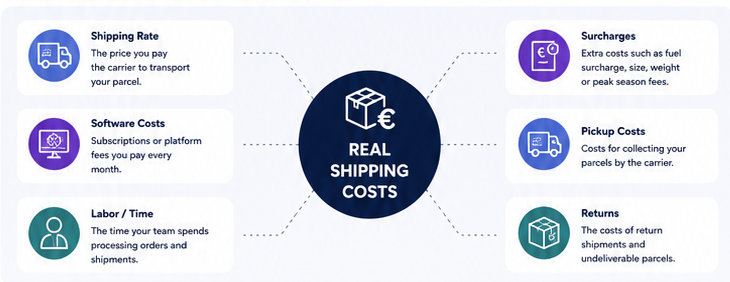
Your real shipping costs include much more than the shipping label itself. You also need to consider surcharges, software subscriptions, label fees, pickup costs, returns and the time your team spends processing every order.
In this guide, we look not only at what business parcel shipping costs in the Netherlands in 2026, but more importantly at how online stores can reduce their total shipping costs.
What is the cheapest way to ship business parcels?
For most online stores, there is no single carrier that is the cheapest option for every shipment.
The most cost-efficient shipping strategy usually combines several factors:
- Use business shipping rates
- Compare multiple carriers
- Use mailbox parcel services whenever possible
- Minimise subscription and label fees
- Avoid unnecessary surcharges
- Automate shipping rules
- Choose the most suitable carrier for each destination
For small and medium-sized online stores in particular, using a shipping platform can be attractive because it may provide access to business shipping rates without requiring you to build large shipping volumes with each individual carrier first.
How much does business parcel shipping cost in the Netherlands in 2026?
The price of a business shipment depends on several factors, including:
- the carrier;
- your shipping volume;
- parcel weight and dimensions;
- home delivery or service-point delivery;
- delivery service;
- insurance;
- destination;
- applicable surcharges.
Business carriers often work with volume-based pricing. As your shipping volume grows, your price per parcel may decrease.
The more parcels you ship directly with a carrier, the stronger your negotiating position can become.
But what if your webshop does not yet ship thousands of parcels per year?
In that case, a shipping platform that combines the volumes of multiple online stores can be an attractive alternative.
Don’t look only at the price of the shipping label
Imagine the following:
€5.80 per parcel
€6.00 per parcel
At first glance, Carrier A appears to be €0.20 cheaper.
But that is only true if all other costs are identical.
These additional costs are often underestimated by online stores.
1. Subscription costs
Some shipping platforms charge a monthly subscription.
€30 per month may not sound significant, but if you ship 100 parcels per month:
A shipment that appears to cost €5.70 therefore effectively costs €6.00 before any other additional costs are included.
Always include software and subscription fees when comparing shipping rates.
2. Label fees
Check whether your shipping platform charges an additional fee for creating or printing each shipping label.
A few cents per label may seem insignificant, but at thousands of shipments per year it can become a substantial cost.
3. Carrier surcharges
A low base rate can become considerably more expensive when a carrier adds surcharges afterwards.
Examples include:
- oversized parcels;
- additional weight;
- incorrect shipment information;
- remote-area delivery;
- fuel or road toll surcharges;
- peak-season surcharges;
- returns of undeliverable parcels.
Mailbox parcel or standard parcel?
One of the easiest ways to reduce shipping costs is to check whether a product really needs to be sent as a standard parcel.
If your product safely fits through a letterbox, a mailbox parcel service may be significantly cheaper.
This can be particularly relevant for online stores selling products such as:
- clothing accessories;
- phone accessories;
- jewellery;
- small replacement parts;
- books;
- cosmetics;
- compact electronics.
Reviewing your packaging can therefore produce immediate savings.
A box that is only a few centimetres too large can turn an inexpensive mailbox shipment into a regular parcel.
Packaging optimisation is also shipping-cost optimisation.
One carrier or multiple carriers?
Many new online stores start by choosing one carrier and sending every order through that company.
It is simple, but it is not always the most cost-efficient solution.
One carrier may offer attractive services for domestic shipping within the Netherlands, while another may be more competitive for Belgium, Germany or France.
The best option may also depend on:
- parcel weight;
- dimensions;
- home delivery;
- service-point delivery;
- international destination;
- required delivery speed.
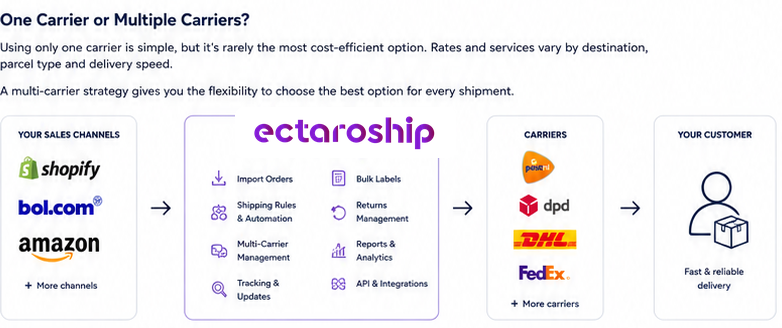
This is why growing e-commerce businesses increasingly use a multi-carrier shipping strategy.
Your shipping platform can then determine which shipping method is most suitable for each individual order.
This selection does not have to be manual. Automated shipping rules can, for example, use:
- destination country;
- parcel weight;
- order value;
- sales channel;
- shipping service.
This allows you to combine price, delivery speed and service.
Do you need your own carrier contract?
Not necessarily.
A direct contract with a carrier can become attractive when your company has sufficient shipping volume and can negotiate favourable conditions.
Smaller online stores often face a disadvantage:
Their individual shipping volume may still be too low to negotiate the best carrier rates.
A shipping platform can combine the shipping volume of many different users and make negotiated rates available to individual merchants.
This can be particularly useful if you:
- are starting with professional business shipping;
- are growing quickly;
- do not want to commit to minimum volumes;
- want to use several carriers;
- do not want to manage a separate contract with every carrier.
Already have a good carrier contract?
That does not mean shipping software has no value. You can still use a shipping platform for order imports, label creation, shipping automation, tracking and inventory management while continuing to use your own carrier agreement.
8 ways to reduce shipping costs for your online store
Compare total costs
Do not compare only the shipping label. Include software fees, surcharges, pickup costs, returns and administrative time.
Use multiple carriers
Different carriers can be better suited to different destinations, parcel sizes and delivery services.
Automate carrier selection
Use shipping rules based on country, weight, order value, sales channel and delivery service.
Optimise your packaging
Smaller packaging can reduce transport costs, dimensional surcharges, packaging materials and storage requirements.
Use mailbox shipping
Analyse your product range and identify which products can safely be sent using a mailbox parcel service.
Audit carrier invoices
Regularly compare the expected shipping-label price with the final carrier invoice and investigate recurring surcharges.
Optimise by destination
The best solution for the Netherlands may not be the best solution for Belgium, Germany or France.
Include labour costs
Manual order processing costs time. Automation can sometimes save more than a small discount on a shipping label.
How much can a small saving be worth per year?
A small difference per parcel becomes significant as your shipping volume grows.
| Saving per parcel | 100 parcels/month | 500 parcels/month | 1,000 parcels/month |
|---|---|---|---|
| €0.10 | €120/year | €600/year | €1,200/year |
| €0.25 | €300/year | €1,500/year | €3,000/year |
| €0.50 | €600/year | €3,000/year | €6,000/year |
| €1.00 | €1,200/year | €6,000/year | €12,000/year |
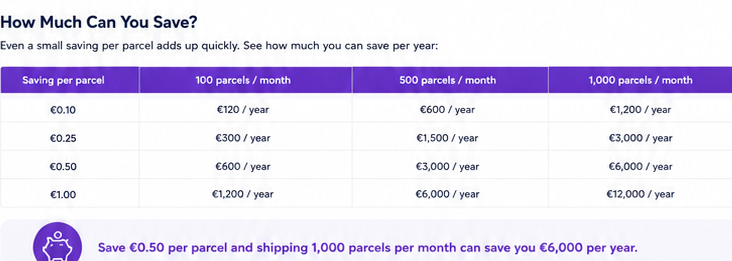
And this calculation only considers transport costs.
If your team also saves time by automatically importing orders, creating labels in bulk and automatically sending tracking information back to the sales channel, the operational savings can be much greater.
Cheaper business shipping with EctaroShip
EctaroShip is designed for online stores that want to manage their orders and shipping processes from one environment.
You can connect multiple sales channels and use different carriers from the same platform.
EctaroShip can help you with:
- Multi-carrier shipping
- Multiple sales-channel integrations
- Automatic order imports
- Shipping-label creation
- Bulk label processing
- Automated shipping rules
- Pick & Go
- API integrations
- Return labels
- Reporting
- Tracking and shipment updates
- Optional inventory management
The objective is not simply to buy a cheaper shipping label.
Which shipping solution is right for your online store?
There is no single carrier or shipping method that is automatically the best option for every webshop.
An online store shipping 50 small mailbox parcels per month has very different requirements from a company shipping hundreds of parcels every day across the Netherlands, Belgium and Germany.
When comparing shipping solutions, consider at least these five factors:
- Shipping price per parcel
- Carrier surcharges
- Fixed software costs
- Available carriers and destinations
- The time required to process each order
If you only compare the first number, you may overlook a significant part of your real shipping costs.
Ready to ship smarter?
Discover which shipping options fit your online store, connect your sales channels and manage orders, labels and tracking from one environment.
Frequently Asked Questions
What is the cheapest way to ship a business parcel in the Netherlands?
The cheapest option depends on parcel dimensions, weight, destination and shipping volume. Mailbox shipping can be attractive for small products, while business carrier rates or a multi-carrier shipping platform can be more cost-efficient for standard parcels.
When does business shipping become worthwhile?
Business shipping can already be interesting at relatively small volumes. As your shipping volume increases, access to better volume-based rates generally becomes more important.
Do I need a carrier contract to get cheaper business shipping?
No. Some shipping platforms provide access to business shipping rates without requiring you to negotiate a separate volume contract with each carrier.
Which carrier is cheaper: PostNL, DHL or DPD?
There is no universal winner. The best option depends on destination, parcel weight, dimensions, shipping volume and required delivery service. Using multiple carriers allows you to select the most suitable option for different shipments.
How can I reduce shipping costs for my online store?
Compare multiple carriers, optimise your packaging, use mailbox shipping whenever possible, monitor surcharges, automate shipping rules and include software and label fees when calculating your total shipping costs.
Can I continue using my own carrier contract?
Yes, if your shipping platform supports your own carrier contracts. This allows you to use the platform for order management, labels, tracking and automation while continuing to ship using your negotiated carrier rates.
What are the hidden costs of parcel shipping?
In addition to the base shipping rate, costs may include carrier surcharges, additional services, returns, pickup costs, software subscriptions, label fees and manual order-processing time. Always compare the total cost per shipped order, not just the price of the shipping label.